

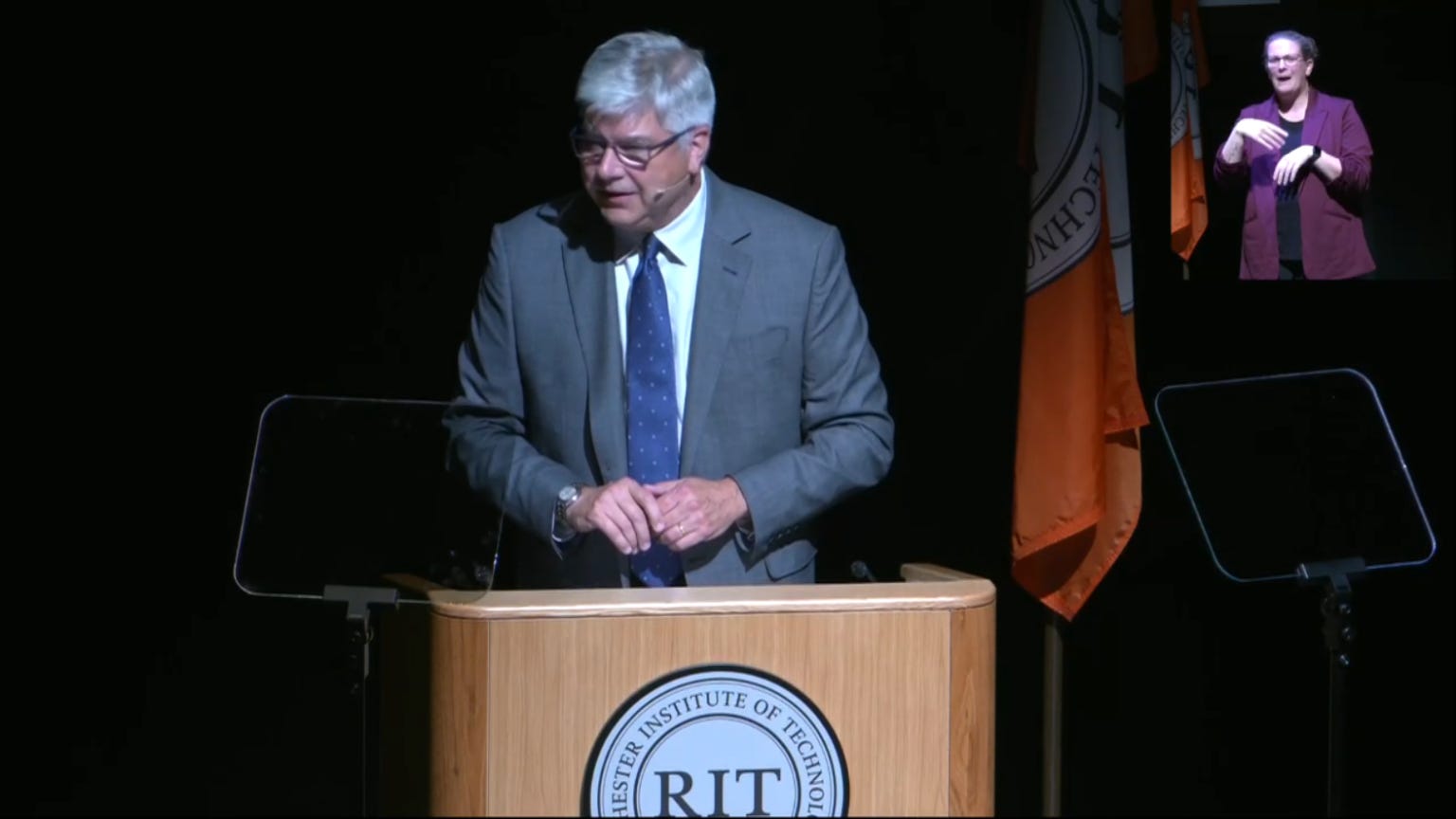
On Thursday, RIT President William Sanders delivered the annual State of the University address to an audience of faculty, staff and students. It was Sanders’ second such address as he begins his second academic year as president. Sanders took office July 1, 2025.
RIT Provost Prabu David opened the event, speaking about the university’s commitment to student success and shifting attitudes toward artificial intelligence. David acknowledged that students and faculty views on AI “vary significantly by field of study.” He then announced a yearlong initiative to “foster shared understanding among faculty and students” and develop department- and college-level guidance rather than prescribe a “top-down institutional answer to AI in teaching and learning.”
David also noted that this was the first State of the University address held in the new RIT Performing Arts Center on RIT’s Henrietta campus. The center opened April 10.
Other speakers, in order of appearance, were Faculty Senate Chair Richard Zanibbi; Staff Council Chair David Brault; Yasmine Ibrahim, President of RIT Student Government; and Keith Jenkins, vice president and associate provost for Access, Engagement, and Success. Jenkins introduced Sanders.
Sanders spoke for about 40 minutes, highlighting a renewed focus on student success. He cited a host of statistics to demonstrate the University’s efforts to expand experiential learning, partnerships with co-op employers, developing new for-credit internships and supporting student entrepreneurs. Sanders also reported strong graduate outcomes, quoting a recent report from RIT recording 93% of graduates were employed or enrolled in graduate school within six months of graduation, an increase from 90% the year prior.
Sanders addressed RIT’s financial challenges, reporting that the university’s revenue remained “essentially flat” while expenses rose by more than $18 million because of “costs that are really out of our control,” including health care and energy costs. He cited those rising costs as a factor in the administration’s decision not to provide merit-based raises to faculty and staff this year.
Sanders also mused on the recent rebound in federal funding for research, saying, “...we had our strongest August ever last month for new research awards as federal agencies, finally, I might add, began moving more funding out the door.” The remark drew some laughter from the audience.
Sanders also highlighted a $24 million commitment from Jeff Harris and Joyce Pratt and growth in RIT’s Sentinel Society annual giving program. He separately cited a goal of creating “at least 200 new scholarship and fellowship endowments” ahead of RIT’s 200th anniversary in 2029.
Included in the $24 million commitment, among others, is an endowed directorship for a new RIT “AI Institute.” The President touched on the already-announced new Institute, describing an “AI institute that builds on successful work in multiple colleges.” Sanders did not elaborate on which, if any, college would house this new institute, how the institute would fit into the larger governance structure, or what kind of work the unit would engage in. As for leadership, Sanders remarked a national search would be announced “in the next few weeks.”
Sanders also congratulated new leaders, including Christine “Chris” Regis, who joined RIT on July 1 as senior vice president and chief financial officer, succeeding Jim Watters. Regis previously served as senior vice president for business and finance and CFO at Southern Methodist University.
Sanders concluded the address by contrasting RIT’s recent investments in major construction projects with a renewed focus on people and programs. “Another important building project is ahead of us,” Sanders said. “This time, we’re strengthening and supporting the people and programs of the university itself.”
Includes reporting by Zack Tyler.
Editor’s note: Jake Streamer is a current graduate student at the RIT College of Liberal Arts. Contributing writer Zack Tyler is an RIT alumnus.
